


 Hover Over To Learn More
- Defining hiring automation
- Implementing hiring automation
- Job Descriptions
- Screening
- Assessment
- Scheduling and Interview
- Offer and Onboarding
- Candidate Management
- Conclusion
How Far Can We Push Automation in Hiring?
Defining hiring automation
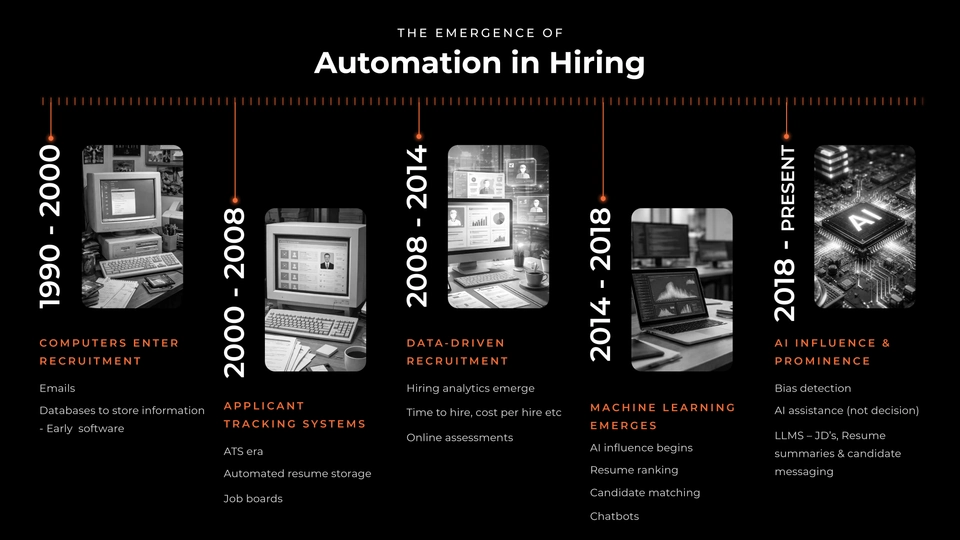
Hiring automation is transforming the way organizations attract, assess, and hire talent in an increasingly competitive job market. At its core, hiring automation refers to the use of software, artificial intelligence (AI), and automated workflows to streamline and manage key stages of the recruitment process with minimal human intervention. From sourcing and resume screening to scheduling and candidate communication, automation helps replace repetitive, time-consuming tasks with faster, more consistent, and data-driven systems.
The purpose of hiring automation goes beyond efficiency alone. It aims to significantly reduce time-to-hire and recruitment costs while improving consistency and fairness across candidate evaluations. At the same time, automation enhances the candidate's experience through quicker responses, clearer communication, and smoother application journeys. Most importantly, it frees recruiters and hiring teams to focus on high-value, human-centered work such as conducting meaningful interviews, building relationships, and making strategic hiring decisions. This is where their expertise has the greatest impact.
Implementing hiring automation
Hiring automation is used across the hiring process, from job advertising and candidate sourcing to hidden ATS functions such as CV screening and ranking, delivering efficiency but it raises significant transparency concerns.
There are concerns around algorithmic bias and the growing need for explainability as regulation increases. There is also strong criticism of AI governance providers for lacking transparency and not meeting the standards they promote, particularly from a candidate perspective.
As a result, a key consideration when implementing hiring automation is on governance, compliance, and inclusion. In people-data–driven organisations, strict governance and local regulations significantly limit what can be introduced, pushing teams to focus first on low-risk, operational efficiencies like interview scheduling and transcript generation. There is a strong emphasis on upskilling Talent Acquisition teams so they understand how automation works and can govern it responsibly. Particularly when tools complement existing products, to minimise legal risk.
In a previous Fairness Network session, we created the TRUSTED framework which is looks at ethical AI in practice. You can learn more and download a copy here.
Now we are going to delve into different part of the hiring process and look at where automation is currently being used and the direction it’s going in.
Job Descriptions
Organisations are increasingly using automation in job descriptions to save time, standardise content across teams, and improve inclusivity by removing biased language to promote clear, skills-based hiring. As of 2025, 66% of organisations are using AI to help generate job descriptions.
Current use of automation in job descriptions focuses on:
-
AI-generated job descriptions
- Produce polished job descriptions based on role titles, skills, seniority, and industry
- Allow adjustments to tone (inclusive, concise, branded), language complexity, and compliance elements -
Skills and competency mapping
- Suggest critical competencies, soft skills, and measurable outcomes
- Map job duties to industry frameworks (e.g., ESCO, O*NET, SFIA)
- Ensure alignment of roles and organizational structure (levels, bands, compensation tiers) -
Bias-mitigation tools
- Detect gendered, exclusionary, or overly aggressive language
- Recommend inclusive wording and improve readability
Cutting-edge practice is now shifting toward:
-
Dynamic, adaptive job descriptions
- Continuously updating descriptions based on market trends, skill availability, and performance data from current employees
- Keep job descriptions current and reduce time-to-update -
Linking roles to outcomes, competencies, and performance metrics
- Instead of listing tasks, key responsibilities with measurable success indicators are defined
- Skills and competencies to be tied to actual performance outcomes
- Aligns the job descriptions directly with performance expectations -
Realistic job previews
- Combining the job description with micro-assessments or scenario-based tasks
- Provide interactive insights into actual work challenges and interactive previews that show daily responsibilities
- Candidates can understand the role better, reducing mismatched expectations and early attrition
Screening
Screening tools, particularly AI-enabled platforms, are transforming early-stage hiring by increasing speed, consistency, and scalability. They help organisations process high volumes of applications efficiently while applying structured, competency-based criteria more objectively than traditional CV reviews. When designed and governed responsibly, these tools not only improve recruiter productivity but also enhance fairness, generate valuable hiring insights, and strengthen alignment between selection decisions and on-the-job performance. In 2025, there was a recorded 88% of companies using some form of AI for initial candidate screening.
Current use of automation in screening focuses on:
-
AI-powered candidate sourcing
- Identify and match candidates across large talent pools and platforms
- Surface passive candidates based on skills, experience, and inferred competencies
- Expand reach while reducing manual search time -
CV ranking and scoring systems
- Analyse applications against predefined criteria and competency models
- Move beyond keyword matching to assess patterns of experience and skill alignment
- Generate structured shortlists to support recruiter decision-making -
Chatbot-led knockout screening
- Conduct automated eligibility checks (e.g., right to work, qualifications, availability)
- Ask structured pre-screen questions at scale
- Provide immediate candidate feedback and streamline early-stage filtering
Cutting-edge practice is now shifting toward:
-
Autonomous and adaptive screening models
- Continuously refine scoring models based on hiring outcomes and performance data
- Integrate structured assessments earlier in the funnel
- Reduce manual intervention while maintaining human oversight -
Team capability building
- Train recruiters and hiring managers to interpret AI outputs responsibly
- Strengthen understanding of algorithmic decision-making and risk
- Embed data literacy into talent acquisition functions -
Bias mitigation and fairness monitoring
- Conduct adverse impact testing across demographic groups
- Apply fairness constraints within algorithms
- Regularly audit outcomes to ensure equitable screening decisions -
Alignment with emerging regulatory standards
- Build compliance with AI governance frameworks and employment law
- Document decision logic and ensure explainability
- Maintain audit trails for scoring and ranking systems
There are growing legal and governance risks of “black box” ranking systems, with potential shared liability between employers and vendors. This highlights the need for built-in fairness, full algorithmic transparency, and stronger governance capability. Especially since many systems lack a clear audit trail of scoring systems. For example, HiredScore is being sued at the due to alleged discriminatory outcomes. As a result, some organisations are moving away from opaque tools and prioritising vendors that can clearly evidence and explain their AI methods.
Assessment
Organisations adopt automation for assessments to better predict real job performance, reduce bias, and integrate assessment data smoothly into existing hiring workflows. In 2025, 46% of organisations used AI for skills assessment scoring and 41% implement AI-driven personality evaluations.
Current use of automation in assessments focuses on:
-
AI-scored skills and technical testing
- Automatically evaluate coding tasks, case studies, language proficiency, or job-relevant knowledge
- Apply consistent scoring criteria across candidates
- Reduce manual grading time while increasing reliability -
Role simulations and work-sample assessments
- Replicate real job tasks to assess applied capability
- Score performance using predefined behavioural or competency markers
- Provide more job-relevant, predictive data than CV screening alone -
Personality and behavioural evaluation
- Use AI-driven analysis to interpret structured psychometric responses
- Map behavioural traits to competency frameworks
- Support team fit and culture alignment decisions
Cutting-edge practice is now shifting toward:
-
Personalised and adaptive assessments
- Adjust question difficulty or content in real time based on candidate responses
- Tailor assessments to specific role requirements or seniority levels
- Improve candidate engagement while maintaining measurement precision -
Real-time anti-cheating and identity verification
- Use proctoring technology, behavioural monitoring, and identity checks
- Detect unusual response patterns or external assistance
- Protect assessment integrity in remote hiring environments -
Predictive talent intelligence
- Combine assessment data with performance analytics to forecast long-term success
- Identify high-potential candidates based on multidimensional data models
- Support workforce planning and internal mobility decisions
Assessments remain one of the most challenging areas, especially as attention grows on neurodiversity and inclusion. Psychometric and interview technologies must be carefully designed to avoid screening out neurodivergent candidates.
In response there are now required changes, there is a growing shift toward reducing or removing unnecessary time constraints, simplifying language and instructions, and offering multiple ways for candidates to demonstrate capability, including written, verbal, or task-based responses. Features such as flexible video interviewing, which allow candidates time to think or re-record responses, are increasingly seen as positive steps toward fairer evaluation.
Overall, there is growing reflection on whether traditional interviews truly identify the best candidate for the role, or simply those who perform best under pressure.
Scheduling and Interview
Interview automation is used to streamline scheduling, reduce administrative burden, improve candidate experience, and scale early-stage screening with consistent evaluation. Organisations adopt it to create more consistent interview processes while freeing recruiters and hiring managers to focus on higher-value interactions. In 2025, a report revealed 82 % of companies regularly conduct video interviews as part of their recruitment process.
Current use of automation in interviews focuses on:
-
Self-scheduling tools integrated with ATS and calendars
- Allow candidates to book interview slots directly
- Sync with recruiter and hiring manager availability in real time
- Reduce back-and-forth communication and scheduling delays -
Automated reminders and virtual interview links
- Send confirmations, calendar invites, and reminders automatically
- Embed video links within invitations
- Decrease no-show rates and administrative workload -
Live and one-way video interviews
- Enable remote, real-time structured interviews
- Use asynchronous (on-demand) video responses for early-stage screening
- Expand geographic reach while maintaining process consistency -
Structured questions with scoring frameworks
- Standardise evaluation criteria across interviewers
- Use rating scales aligned to competencies
- Improve reliability and fairness in decision-making
Cutting-edge practice is now shifting toward:
-
AI-driven adaptive interviews
- Adjust follow-up questions dynamically based on candidate responses
- Probe deeper into relevant competencies in real time
- Create more personalised yet structured interview experiences -
Identity verification and AI-enabled proctoring
- Confirm candidate identity during remote interviews
- Detect potential misconduct or third-party assistance
- Protect integrity in virtual hiring environments -
Multimodal analysis (video, audio, and text)
- Analyse speech patterns, language use, and response content
- Generate structured summaries and scoring insights
- Support interviewer decision-making with additional data points -
Bias-aware, explainable AI with human oversight
- Provide transparent reasoning behind automated insights
- Monitor for adverse impact or unfair outcomes
- Maintain final decision authority with trained human interviewers
Offer and Onboarding
Offer and onboarding automation is used to streamline tasks, standardise processes, and deliver a faster, more secure, and more consistent candidate experience, with strong integration across the HR tech stack. At the end of 2024, there were 28% of firms using AI for onboarding new hires.
Current use of automation in offer and onboarding focuses on:
-
Automated offer generation and approval workflows
- Create standardised offer letters using pre-approved templates
- Route offers through digital approval chains
- Reduce delays and manual errors -
Digital contract management and e-signatures
- Issue, track, and store contracts securely
- Enable remote signing and automated reminders
- Maintain compliance and audit trails -
Onboarding workflow automation
- Trigger task lists for HR, IT, payroll, and hiring managers
- Automate equipment requests, system access, and documentation
- Ensure consistent processes across departments and locations -
HR system integration
- Sync candidate data directly into HRIS, payroll, and benefits platforms
- Minimise duplicate data entry
- Improve data accuracy and reporting continuity
Cutting-edge practice is now shifting toward:
-
Personalised onboarding journeys
- Tailor content, learning modules, and introductions based on role, location, or seniority
- Adapt onboarding timelines to individual needs
- Increase relevance and engagement from day one -
Multilingual and inclusive onboarding design
- Provide translated materials and accessible formats
- Embed inclusive messaging and belonging initiatives
- Support diverse, global workforces -
Immersive and interactive experiences
- Use interactive platforms, video walkthroughs, and virtual office tours
- Integrate gamified learning modules and milestone tracking
- Enhance early engagement and organisational connection
Candidate Management
Process and candidate management automation is used to support evaluation and communication. Organisations use it to deliver a transparent, two-way candidate experience, ensure consistent and compliant selection processes, and provide structured feedback. In 2026, it’s reported 73% of candidates want more personalized feedback that AI-driven platforms can provide.
Current use of automation in candidate management focuses on:
-
Digital scorecards and structured evaluation forms
- Standardise interviewer ratings against predefined competencies
- Reduce subjectivity through consistent scoring criteria
- Maintain documented rationale for hiring decisions -
Centralised written notes and recommendations
- Capture structured interviewer feedback in one system
- Generate consolidated hiring summaries
- Improve collaboration and audit readiness -
Automated and manual candidate outreach
- Send stage updates, next steps, and rejection communications
- Personalise messaging at scale using templates
- Maintain consistent employer branding -
Applicant surveys and feedback collection
- Gather candidate experience data post-interview
- Identify drop-off points or dissatisfaction trends
- Inform continuous process improvement
Cutting-edge practice is now shifting toward:
-
Instant AI-generated feedback for candidates
- Provide structured, competency-based summaries after assessments or interviews
- Offer actionable development suggestions
- Improve transparency and perceived fairness -
Explainable AI-driven recommendations
- Present clear reasoning behind candidate rankings or progression decisions
- Highlight strengths, development areas, and role alignment
- Support accountable, human-led final decisions -
AI-powered personal career coaching
- Offer candidates tailored guidance on skill gaps or alternative roles
- Suggest learning resources or future-fit career pathways
- Extend value beyond a single application process -
Automation of repetitive interactions with human oversight
- Handle routine updates, FAQs, and scheduling communications automatically
- Escalate key moments (offers, rejections, complex queries) to human recruiters
- Balance efficiency with empathy and relationship-building
Conclusion
Hiring automation is already embedded across the recruitment lifecycle, delivering clear gains in speed, scale, and consistency. When applied well, it improves candidate experience and frees talent teams to focus on high-value, human decision-making.
However, the limiting factor is no longer technology; it is risk. As automation becomes less transparent, organisations face growing exposure to lack of explainability, regulatory non-compliance, and reputational damage. These risks are most acute in screening and assessment, where poorly governed tools can disadvantage neurodivergent candidates and prioritise performance under pressure over real job capability.
The core question is not how far automation can go, but how far it should. Sustainable value comes from automation that supports fair, explainable human decisions, not from removing humans from the process.
Start Building a Fairer Workplace With Us
Dive into the future of work with our expertly crafted solutions. Experience firsthand how MeVitae’s AI-driven solutions can make a difference. Request a demo or consultation now.